
Renderers
About Renderers
Artifacts are stored as submitted by the user using SSTORE2.
When users call the uri() method, the token checks for its registered renderer contract and hands off rendering of the metadata to the specific token renderer.
/// @notice Get the metadata for a given token id.
function uri(uint tokenId) external override view returns (string memory) {
    if (tokenId > latestTokenId) revert NonExistentToken();

    Token memory token = tokens[tokenId];

    return IRenderer(renderers[token.renderer]).uri(tokenId, token, artifact(tokenId));
}

/// @notice Read an artifact.
function artifact (uint tokenId) public view returns (bytes memory content) {
    Token memory token = tokens[tokenId];

    for (uint8 i = 0; i < token.artifact.length; i++) {
        content = abi.encodePacked(content, SSTORE2.read(token.artifact[i]));
    }
}
All renderers have to implement the simple IRenderer interface. They receive the tokenId, the token metadata (name, description, ...).
interface IRenderer {
    function name () external pure returns (string memory);

    function version () external pure returns (uint version);

    function uri (uint tokenId, Token calldata token) external view returns (string memory);

    function imageURI (uint tokenId, Token calldata token) external view returns (string memory);

    function animationURI (uint tokenId, Token calldata token) external view returns (string memory);
}struct Token {
string name; // token name
string description; // token description
address[] artifact; // artifact pointers (image/artwork) data
uint32 renderer; // index of renderer contract address
uint32 mintedBlock; // creation block height of the token
uint64 closeAt; // timestamp of mint completion
uint128 data; // optional data for renderers
}How renderers generate the metadata is entirely up to them.
Default Renderer
The base renderer implementation that ships with every Mint contract by default simply returns artifact data as a blob.
contract Renderer is IRenderer {

    /// @notice Render the metadata URI of the token.
    function uri (uint tokenId, Token calldata token) external view returns (string memory) {
        bytes memory artifact = ArtifactReader.get(token);

        bytes memory dataURI = abi.encodePacked(
            '{',
                '"id": "', Strings.toString(tokenId), '",',
                '"name": "', token.name, '",',
                '"description": "', token.description, '",',
                '"image": "', artifact, '"',
            '}'
        );

        return string(
            abi.encodePacked(
                "data:application/json;base64,",
                Base64.encode(dataURI)
            )
        );
    }

}
Renderer Extensions
P5 Renderer
As an initial extension example, we have built a renderer for generating p5.js based artifacts onchain.
Check out the P5Renderer.sol on Github.
This renderer also comes with its custom UI implementation to edit and preview the P5 script.
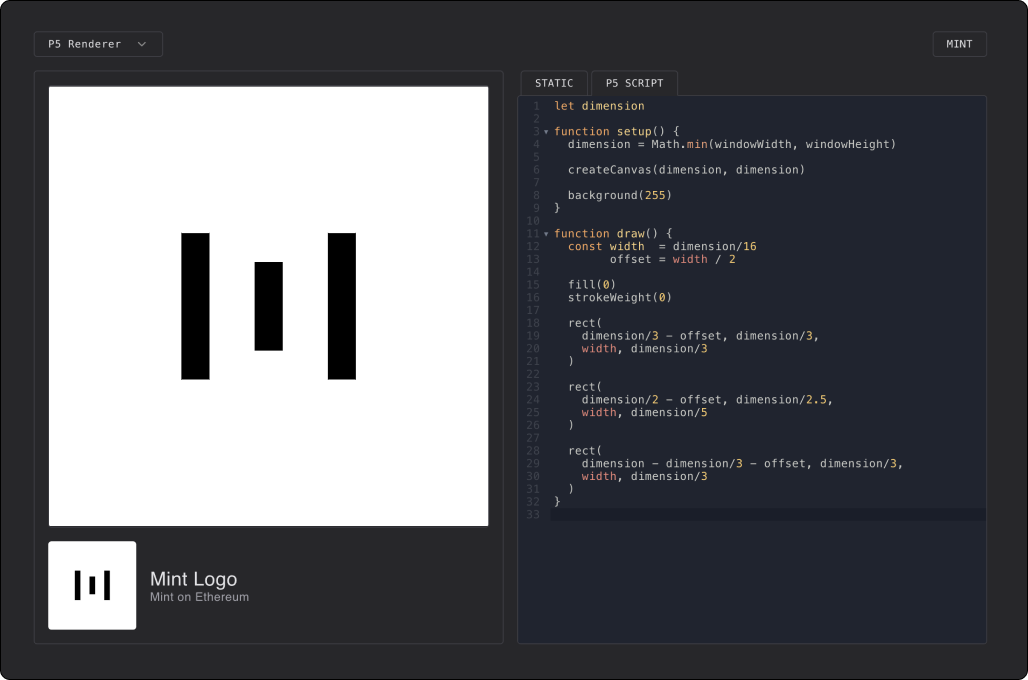
How this works under the hood is that we encode both the static asset and the script content within the artifact bytecode, and decode it into its parts during rendering.
Also note how the renderer exposes both a script_url with just the artists' p5 script and the complete animation_url with the entire encoded html page.
/// @notice Generate the JSON metadata for a given token.
///         We expect the static preview image and P5 script
//          to both be encoded in the artifact data.
function uri (
    uint tokenId,
    Token calldata token,
    bytes memory artifact
) external view returns (string memory) {
    (string memory image, string memory script) = abi.decode(artifact, (string, string));

    bytes memory dataURI = abi.encodePacked(
        '{',
            '"id": "', Strings.toString(tokenId), '",',
            '"name": "', token.name, '",',
            '"description": "', token.description, '",',
            '"image": "', image, '",',
            '"script_url": "data:text/javascript;base64,', Base64.encode(bytes(script)), '",',
            '"animation_url": "', generateHtml(token.name, script), '"',
        '}'
    );

    return string(
        abi.encodePacked(
            "data:application/json;base64,",
            Base64.encode(dataURI)
        )
    );
}
Markdown Renderer
The Markdown Renderer is designed for text-based artifacts. The artifact is stored as raw markdown bytes.
Check out the MarkdownRenderer.sol on Github.
For the image, the renderer generates an on-chain SVG preview — a dark 400×400 card showing the token name as a heading and a truncated, sanitized snippet of the markdown content that fades out via a CSS mask gradient.
The full markdown content is exposed as a base64-encoded data:text/markdown data URI via the animation_url.
function uri (uint tokenId, Token calldata token) external view returns (string memory) {
    bytes memory artifact = ArtifactReader.get(token);

    bytes memory dataURI = abi.encodePacked(
        '{',
            '"id": "', Strings.toString(tokenId), '",',
            '"name": "', token.name, '",',
            '"description": "', token.description, '",',
            '"type": "markdown",',
            '"image": "', _generateSVGDataURI(token.name, artifact), '",',
            '"animation_url": "', _markdownDataURI(artifact), '"',
        '}'
    );

    return string(
        abi.encodePacked(
            "data:application/json;base64,",
            Base64.encode(dataURI)
        )
    );
}
To safely embed user content in SVG, the renderer sanitizes XML entities (&, <, >, ", ') and truncates the preview to 800 bytes.
Tone Renderer
The Tone Renderer powers audio-based artifacts using Tone.js. Like the P5 Renderer, the artifact is an ABI-encoded (string image, string script) tuple containing a static preview image and a Tone.js script.
Check out the ToneRenderer.sol on Github.
The renderer assembles a self-contained HTML page via scripty.sol that loads Tone.js (gzipped) from EthFS and runs the token's script. The HTML is built using ScriptyBuilderV2 with the following structure:
- Head:
<title>tag +fullSizeCanvas.cssfrom EthFS - Body: gzipped Tone.js from EthFS, a gunzip loader script, and the token's audio script
function uri (uint tokenId, Token calldata token) external view returns (string memory) {
    (string memory image, string memory script) = abi.decode(ArtifactReader.get(token), (string, string));

    bytes memory dataURI = abi.encodePacked(
        '{',
            '"id": "', Strings.toString(tokenId), '",',
            '"name": "', token.name, '",',
            '"description": "', token.description, '",',
            '"image": "', image, '",',
            '"animation_url": "', generateHtml(token.name, script), '"',
        '}'
    );

    return string(
        abi.encodePacked(
            "data:application/json;base64,",
            Base64.encode(dataURI)
        )
    );
}
The renderer also exposes a scriptURI() method that returns just the Tone.js script as a data:text/javascript data URI.
Community Renderers
Developers are invited to get creative and contribute their own to the ecosystem.